Thursday, April 12, 2012

Practice with Sharath

Check out who I practiced led-Primary with on Tuesday morning:

Me and Sharath post practice
Sharath Jois and Saraswathi!  Grandson and daughter of Pattabhi Jois (a.k.a Guruji, founder of Ashtanga Yoga).  My friends and I road-tripped down from Boston on Monday night to practice with them in Greenwich, CT.  My friends were fresh from a month of studying with them in Mysore, India (they kept a great blog going while they were there, check it out: Ashtanga 4 Life); this would be the first time that I met either of them.  Sharath and Saraswathi were only planning to visit the East Coast once this year during this time to help open the Jois Yoga shala (studio) in Greenwich, so I didn't want to pass up the chance to practice with them when they were practically in my backyard.  When I signed up, I was unaware that this was actually one of the studios that was coming under a bit of scrutiny from some people in the Ashtanga community.  Basically, the issue that some people seem to be having is that these new studios are a chain and are super fancy, and they are worried about Ashtanga Yoga becoming a brand, that the name is becoming more important than the method.  I won't rehash the whole article, that came out in Vanity Fair of all places, because I don't know enough about what's going on or have enough knowledge of how things were done during Guruji's time; but you can read it here if you're curious. 

Also, that's not what I want to talk about here, I want to talk about what it was like to practice with someone who studied as close as anyone possibly could with the person who created Ashtanga Yoga, and who continues to direct and teach at the main shala in Mysore.  How was it?  Very sweet...that's the best word I can think of for it.  Yes, the new shala is super fancy with a high-end boutique in the front.  But that's not the yoga--doesn't matter how fancy the space may be, we were all still squeezed in there together, sweating and bumping in to each other some of the poses because our mats had to be so close in order to accommodate all the people who came.  While we were waiting to start, Sharath said, with that awesome smile of his, "It's not enough that you practice Mysore, you have to experience Mysore!  Bring the mats closer!"  And all that new studio fanciness, that's not Sharath. 

Sharath speaking with a student before the next class (that's Guruji in the painting)

My friends and I ended up being in the very front row and I was directly in front of his chair; front and center, not my favorite place to be in a class, lol.  But he had this wonderful, non-intimidating presence that just reflected his attitude that he does not consider himself to be a guru, he is still thinks of himself as a student.  You could just see from his smile and his attitude that he just seemed so happy to just be there teaching and sharing the yoga.  I really liked the way he taught the class too--the pace was perfect, much slower than I had heard about from some people (my own pace tends to be pretty slow, so I was a little concerned about that, lol).  His tone of voice was calm, quiet and a little humorous too, teasing us by counting slower when we got to Navasana (an intense abdominal strengthener that comes in the middle of the Primary Series that you repeat 5 times and hold for 5 breaths each) and Utplutihi (the last pose of a class where you sit in lotus, or cross-legged, and hold your legs/bottom half off the floor for 10 breaths), "Don't come down!  Don't drop the legs!  Lift back up!"

At the end of the class, there was no promoting the new studio or any sort of advertising.  All he said at the end was that it was important to practice everyday; that if you had 2 hours to spend on Facebook everyday, then you could spend 2 hours on your yoga practice (I'm summarizing, he said it much better, lol).  It was really nice to be able to practice with him and Saraswathi and get a little bit of first hand experience of what they are like.  And it's always nice to see how big and connected the community of Ashtanga practitioners are.  Ashtangis are a dedicated bunch of people and that seems to connect us: India, New York, Connecticut, Boston, Cambridge...even if we've never met each other before.


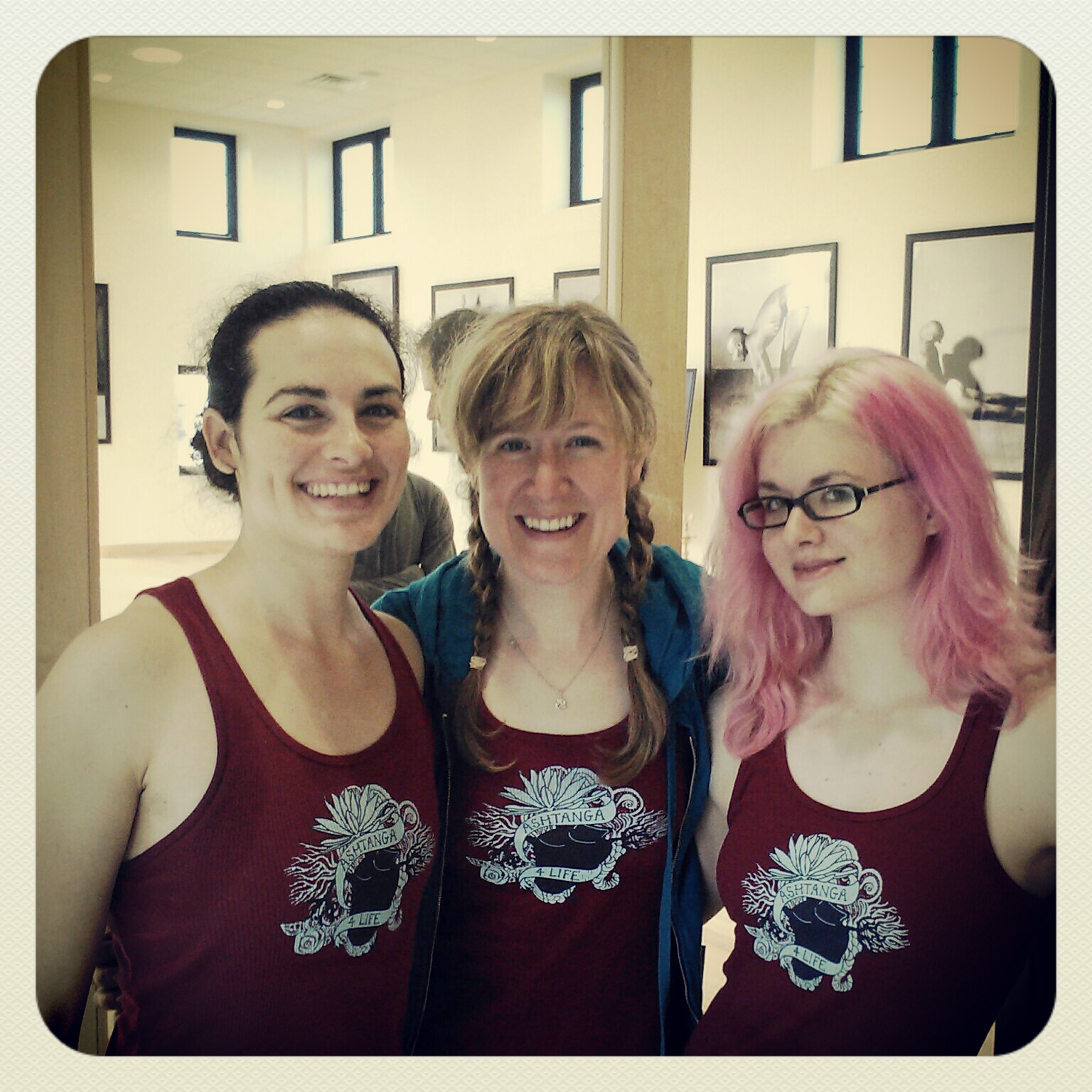
Me, Cara and Cyndi (part of "Team Boston")


Wednesday, April 11, 2012

I'm still here!

First off, apologies for the 2-month long absence from the blog.  I tend to go through phases when I feel like writing about everything and then when I don't feel like writing about anything.  Clearly I've been in the latter phase.

When I last wrote in my blog I was in a bit of rut.  I was going to practice but it just didn't feel good, it felt tiring.  I was also getting over a persistent cold that lasted nearly 2 weeks and ended up re-visiting me with re-newed intensity near the end of February.  Not cool.  The "gremlin" that I thought was just pinched up and pissed off muscles from all the coughing ended up being a slight rib dislocation/fixation from all the coughing!  Meaning that one of my rib heads had gotten a little out of place (not a complete dislocation) and then got stuck (kind of like when a joint gets frozen).  Good times.  Well, the rib has been put back into place (through much pain...ouch!) and the only remnant is that every now and then those muscles are a little achy.  The practice continues to roll on...

Actually, practice has been pretty fantastic lately.  The visiting teacher (Karen Breneman) who was subbing for my regular teacher while she was in India had me start practicing drop-backs again.  Kate (my regular teacher) had put them on hold because I would get extremely light-headed while doing them--to the point where it felt like there was so much pressure on my head that I felt slightly nauseous and near blacking out.  As much as we could tell, a large part of this has to do with my low blood pressure.  When I told this to Karen, she suggested I go as slowly as I can and, before sitting down for Paschimottanasana, pause in a half forward bend so that my blood pressure has a chance to equalize.  That one little suggestion ended up making a huge difference!  No more intense pressure when I sat down for Paschimottanasana.  It felt so good to be doing drop backs again.  Almost liberating....at first, lol.  And then my mind caught up with me and, for some reason, my brain started freaking out whenever it came time to work on my drop-backs.  Even though my form looked great, inside my nerves were all over the place.  I started getting more light-headed when I did them, though not dangerously so.  I kept doing them even when the light-headedness returned because (a) I figured that the only way I was going to figure out what was causing the light-headedness was to keep doing them, and (b) they presented this fantastic opportunity to work with my reaction to fear.  Finally, one day when I was getting ready to stand up from the first one, I could feel the fear coming up and with it my neck muscles clenching up!  That part was the last piece of the puzzle for me.  Kate had said it before but I just never really connected it: my neck muscles getting tight during dropbacks was cutting off the blood circulation to my head!  Now, before I stand up, I make a point of checking in with the neck muscles to see if I'm gripping them...which also means that I need to make sure my shoulders haven't crept up towards my ears.  For me, no matter how much the drop-backs might be freaking me out, I have to make sure I'm very relaxed in order to do them safely.  Since Kate has come back, she's also made a point to check that area every time we do drop-backs.

Since figuring out those two critical pieces to backbending for me, doing drop-backs has become this amazing liberating and empowering experience for me.  It's liberating because it feels so good for my body--very freeing because it feels like there's so much more space.  It's been empowering because, for me, there is a great deal of trust that I have to have in myself in order to do these.  Trust that my legs will be strong enough to support me and that I know enough and have enough awareness now to practice these without hurting myself.  I've also noticed that it feels like it's had an interested effect on my emotions.  I know that for some people, back bends tend to make them more emotional, bringing up all sorts of latent anger or sadness.  For me, it's had more a balancing effect!  Freeing and stabilizing all at the same time.  Now, on days when I don't do them I tend to feel less stable and heavy...almost like a "weighted down" feeling.

Since my teacher came back at the end of March there has also been 2 new additions to my practice: the next 2 poses in the Intermediate Series, Ustrasana and Laghu Vajrasana (she gave them to me last Wednesday).  I was not in a hurry to get Ustrasana because, in the past, it has been my least favorite back bend, primarily because I could not figure out how to support the backbend without having my arms to hold it up/support it (like you would in Urdhva Dhanurasana) and the entire bend felt like it ended up dumping into my lower back, which was not the most pleasant feeling.  Well, at some point during all those drop-backs, my body must have figured it out, because it felt great!  The other one, Laghu Vajrasana was...interesting, lol.  I've heard everyone else's horror stories with it and have seen people practicing and struggling with it, but I had never attempted it before, so I had no idea how it would feel for me. 

Here's Megan from Damn Good Yoga showing an exquisite example of Laghu Vajrasana
Well for one thing, it's hard, lol!  Holy quads Batman!  I knew that's one area the pose was supposed to strengthen, but I don't think you can ever completely understand it until you try it.  My quads were on fire for 2 days after the first attempt at it, lol.  It was also completely discombulating for my brain.  Kate explained how to do it and then had me try and I said, "wait, where do my hands go?"  And I tried lowering down and my brain thought, "wait a second, how am I supposed to do this and keep my arms straight, that doesn't make any sense!"  It has also been a very humbling pose because I can't do it yet.  I get about 3/4 of the way down, try to hang on, lose it and...splat!  Right on top of the head.  And trying to come up from it...not even close, lol.  It's hilarious.  I can't do anything but laugh at it.  When I was first attempting this pose, I was focusing so hard on trying to do it that I was hesitating to completely go for it, because I could feel that I was going to lose it.  Kate saw that and said, "it's ok if you crash and burn."  And, oddly enough, it feels really nice to not get it on the first try, to have to work for it.  Being physically active for nearly my entire life and having a good amount of natural flexibility, it's not hard for my body to be able to just do things without having to work really hard at it for a substantial length of time.  So, this feels nice; to not be perfect or good at something right away.  And even if I'm not able to completely do the full posture right now, the effects of simply just trying to do the posture are showing.  Not only do my legs feel stronger (like they used to when I was a runner, hello legs!), but practicing the pose has been a big help in my drop-backs!  I feel like I have even more control over them now and the landing is super soft and light! 

There are lots of things clicking together in my practice right now and it just feels soo good.  Peaceful, empowering, stabilizing, liberating...I'm loving it so much right now that when I finish, the first thing that comes to my mind is, "I don't want to stop.  I feel like I could just keep going."  I leave the studio to go to work and the first thing I think about is how soon I can come back and do it all again.

Sunday, February 5, 2012

Inspiration

When you're low on prana, sometimes it helps to visit your sources of inspiration.  The first comes from a phenomenal lady named Steph Davis.  Steph Davis is a climber who is known for free solo climbing up huge cliffs and rock towers--meaning she climbs without a rope and she's thousands of feet above the ground!  She has also taken to jumping off those high cliffs (often after climbing them) either via parachute or wing suit.  Talk about mastering your fears!  Dealing with fear is something she talks about a bit in this video and that's one reason I find it inspiring:


The other big source of inspiration is, of course, the yoga (even when it's feeling a little rough).  And I really love the way Kino Macgregor (who is a pretty inspiring person herself) talks about it in this video because she talks more about the longevity of the practice--something that's inspiring when you go through periods of "slump."


Wednesday, February 1, 2012

Tara has no prana...


Yeah, it kind of feels like that.  Most of January actually (hence the month long absence from the blog).  I was sick for nearly the whole first 2 weeks of January with some kind of head cold that everyone seemed to be getting.  I don't usually get sick that often (I didn't get sick at all last year, minus the last couple of days in December when the cold started to settle in) and when I do it doesn't usually stay with me that long.  This one, however, knocked me on my ass.  It wasn't even that there were a lot of symptoms--no fever, no throwing up.  Just a lot of congestion, coughing, achy muscles (that was the first symptom) and a huge energy zap--due largely to being unable to get a full night's sleep courtesy of the coughing and congestion.  I tried everything in my home remedies tool box to fight it without meds: hot water with lemon, ginger and honey, neti pot, cut out all the dairy, ate spicier foods, shots of apple cider vinegar...nothing helped.  I kept my practice up for a little while and always felt a little better afterwards, but I finally had to stop that too because I just didn't have the energy for it.  I finally caved, took a sick day at work and got some Advil PM and Mucinex.  2-3 days later, I was sleeping through the night and feeling better--though I had some really bizarre dreams.

So, the cold finally cleared out but my body felt like it had been through a train wreck.  Body was exhausted, energy was depleted and my appetite and digestion felt completely off balance.  Sugar snuck its way back in, almost felt like it needed to after eating so many spicy foods.  Now the appetite is feeling a little more normal and I'm working to kick the sugar back out of my system (or at least as minimal as possible).  I may enjoy the taste of sugary foods (can't lie on that one) but it always messes with my mental and emotional state--I feel better in that sense with it kept to an aboslute minimum.

My energy is still touch and go right now and, more often than not, my practice feels very tiring (as evidenced by the 30 minute savasanas I've been taking).  All the days of coughing also left a very annoying, and very persistent, knotted/pinched up muscle right next to my right shoulder blade.  When I try to use that muscle or "round the upper back," it's like there's some kind of vise in there that clamps down on it.  Not fun.  That's been hanging around for about 2 weeks--even after some seriously deep tissue massage.  Tennis ball massage, heat, arnica gel...nothing.  This "gremlin" (as Kai at The Reluctant Ashtangi likes to call them) does not want to let go.  My knees have been a little achy as well and my right foot (the one that had the surgery) has suddenly started feeling pinched up and achy as well.  I've also noticed a tenderness/tightness in the attachment area of the left hamstring--which could spell hamstring tear if I push it.  It's not an injury yet and I'm hoping to keep it that way, so I'm being very careful in my forward bends right now.  Add in some tenderness and mild pain in my low back/SI joints following a cranio sacral session (the session was good, but it appears to have stirred up something in my lower back/sacrum area).

Today my friend was explaining to me and a couple of other friends at the studio how you could tell how the prana (the vital life force/energy in your body) was moving in your body by what direction a dangling pendant was spinning (called "dowsing").  If the pendant spun/rotated towards you, then your prana was in balance; away from you and it was out of balance (he said you could also tell which foods were good for you via the same method: toward you = good, away from you = bad).  I watched my friends hold it and saw how it move even though they were very clearly not moving their hands or arms. 

When I held the pendant--no movement.  Tara has no prana, lol.  Which of course is not possible, lol.  My friend suggested that something was probably just blocking it.  With the state my body is in, I don't doubt it, lol.

Oiy, here's hoping February is an improvement...


Saturday, December 31, 2011

Easing into 2012


I love Garfield.  I read that in the Boston Herald newspaper yesterday and it really resonated with how I'm feeling about the coming year.  At the start of last year, there was a lot that needed to change in my life.  The big change of course was the new job, but a lot of 2011 was about letting go of a lot of things and not resisting the changes as they came.  In 2010 I was holding on to my yoga practice way too tight, refusing to let it change in any way that I didn't want it to.  My then-boss had said that I was dictating my whole schedule and forcing everyone else in the office to work around it.  Ironically, this year, in order to go deeper into my practice via the teacher training, I had to be willing to let it go, to let it change in ways that I wasn't actively pursuing.  With the new work schedule and the addition of dog-walking and dog-sitting, I suddenly was not able to practice with as wide a variety of teachers and classes as I used to.  At first I was bummed out because I had grown close to a couple of the teachers.  But, it was a change that definitely needed to happen (it kind of seems like that's how all unplanned life changes seem to be) and that I was ready for.  My Ashtanga practice became my home, the place where everything that I learned from the training and all my past teachers had a chance to actually integrate--rather than constantly bouncing between classes and teachers and taking in new information. 

Now, my practice is at a place that feels more sustainable and more intelligent and mature.  And so does my life, for now at least.  It still feels like there are some significant changes waiting just on the horizon for me next year (I've heard that's kind of a given when you start really practicing the Intermediate Series, lol) and I'm really curious to see where my practice goes and what changes will come in my life next year.  But it doesn't feel like there's anything that I have to actively "do" or change.  No big "resolutions" or intentions.  Just keep doing what I'm doing but be alert and open to changes when they come.  Even my body is on the same page for this one...yesterday I started fighting a cold.  Nothing huge, just enough to sap my energy.  So, no midnight yoga class or party with friends.  Sleeping, that's probably what I will be doing during the transition from 2011 to 2012, lol.  My first practice of 2012 will probably not be some grand feat of physical strength or endurance.  No 2 hour Yoga Mala (108 suns) like last January.  Though it might be heated because it feels like my body needs it to help sweat out whatever has taken up residence in my body, lol.  We'll see how it goes ;-)

See everyone in 2012!


Saturday, December 17, 2011

Ninja chakrasanas, Bhekasana, achy knees and a new way to flow

This week's practice was a little bit of a mixed bag--both in how it went and in what I practiced.

Sunday I took a break from the Ashtanga practice for 2 reasons.  One, my body needed it after the intensity of last week ;-)  Two, my very first yoga studio, Healing Tree Yoga, in Quincy, MA was holding a free yoga weekend (meaning every yoga class was free!).  It had been well over a few months since I'd been back to visit my teachers there so this seemed like a good opportunity.  It was really nice, felt like going back home.  Healing Tree is such a sweet little one-room studio and the quality of teaching there is on level with anything that I've seen at some of the bigger studios in Boston.  Even better sometimes because the class sizes are smaller so there's more opporutnity for discussion and individual attention.  It was so good to take class with my first two teachers from there, just to hear their voices and their instructions again.  It also made me realize how much I've grown since then.  During my first couple of months of yoga my emotions ranged from being extremely unhappy and feeling lost in my life to being ecstatic at this new way of moving that I couldn't even really understand yet.  In my practice I remember wanting to do all the hardest things that they could throw at me, just show that I could do it.  I can feel now that there is much more intelligence in the way that I practice and more fluidity--I don't have to concentrate as much on "what" I'm doing, it just flows more easily and organically.  I guess 2 years of daily practice and a teacher training will do that to a person!  It was also good to be able to talk with my teachers from there, even if most of the time it focused on them encouraging me to teach even though I don't feel ready.  "You're never going to feel ready Tara."  Probably true, lol, but it doesn't feel like it's time yet.  Is it weird that even though I've had a daily practice for 2 years I still don't feel like my practice is...stable?  I think that's the word I'm looking for.  I don't feel strong enough and stable enough in my own practice and life to be able to teach yoga to other people.  My teachers don't buy that explanation, lol, but that's how I feel.  Both of them offered to talk with me and help me in whatever ways I might need in order to get me moving in that direction and it's nice to know that I still have that support if I need/want it.

Monday was back to the Ashtanga room.  Practice was still flowing smoothly with the straight leg jump-throughs and I'm pretty sure they're here to stay.  It's so weird, it feels so natural and smooth now that it feels like I've been doing them that way for years, rather than just a couple of weeks!  I feel like at some point, after lots of practice, something just "clicks" inside and suddenly the body just understands how to do it.  I think a lot of it actually has to do with not thinking too much about "how" to do it.  That entrance to supta kurmasana from seated is still kicking my ass but my back is adapting quickly and it doesn't feel quite as tight as it did (I also got a 15 minute massage while I was at Healing Tree, so that probably helped too).

Tuesday was actually a home practice because I had an 8am-1pm time window for the gas company to come and replace the gas meter.  I didn't want to lose the momentum that my practice was building up, so I convinced myself to get out of bed just after 5:00am and do my practice at home.  At first, my body was not impressed and was completely against the idea of moving, lol.  I ended up doing about an hour of restorative/yin type poses before I actually started my Ashtanga practice.  And even after that, my body still felt stiff and it felt very hard to find the rythym and even to get the breath really moving.  It's hard to say why practice felt so sluggish that morning, almost like my mind was too engaged and my body too tired.  In the past when I've felt similarly, the standing balances tend to work really well to get me focused and connected.  Tuesday, not so much.  It felt like energy and focus were just not going to be there.  So, I had resigned myself to finish the standing poses and then move into doing something else once I got to the seated poses.  Odd thing happened though, as soon as I jumped through to the first seated pose, it was like a little switch got flipped on and suddenly, there I was--settled into my practice and ready to go.  The rest of it was pretty smooth sailing.  I was also pretty excited to practice the seated entrance to supta kurmasana a little differently--seeing as how I was at home and could do whatever I wanted ;-)  I'm "supposed" to put the left leg behind my head first and then the right.  But, as I've said before, I'm no where close to being able to do this "properly" and the left side of my back is getting tighter and "denser" than the right.  So, I tried with the left leg first and then I tried with the right as well.  The right side is actually a little easier, but that doesn't surprise me, my right hamstring is much more open than the left.  I still got no where close to coming into Supta K from seated but it gave me some good information on what I need to work on with the left side of my body.

I also went to a vinyasa class in Jamaica Plain with a teacher that I really like.  It's actually starting to become a regular thing to go to her class once a week (usually either Sunday or Tuesday).  I really like the way that she teaches.  She has a lot of energy in her classes but it's also really light and fun.  The other thing that's really cool is that she trusts her students.  You can tell by her cueing and the poses that she offers that she trusts both the physical ability of her students as well as their judgement in attempting the poses that she offers.  She also almost always includes some arm balances and fun transitions as well as inversion time--which I love.  I go to her classes to play :-)  She also challenges me by throwing things at me I don't normally do because she knows that I can do them.  My handstand is also getting much more stable because of the time I spend in this class.  I can find the balance pretty easily knowing the wall is in front of me and have been finding some "hang-time" pretty regularly now.  It actually almost feels calming.  She also had us do something really cool and fun on Tuesday night: she gave us the option to drop into chaturanga from a tripod headstand.  It was awesome!  You kind of feel like a rockstar when you do it, lol.  And I think it had a positive influence on my Ashtanga practice the next morning.

Wednesday morning, I did something in my practice that I have never done before.  I landed directly in chaturanga from my chakrasana!  I wasn't even trying to or even just thinking about it--my body just did it!  I lifted my legs up on the inhale, exhaled and pressed into my hands and all of the sudden I rolled over my head and landed directly in chaturanga.  I got this awesome little boost of energy from doing it and now it makes even more sense as to why it's in the series.  I feel like the tripod to chaturanga that I did in the Tuesday vinyasa class was the thing that kickstarted this because the movement is similar.  Once my body got a feel for the movement, it just naturally incorporated it into the chakrasana!  A friend of mine said that the few times that she's managed to do that she always feels like Chuck Norris.  I totally agree, you feel like this awesome combination of rock star and ninja, lol!

However, a little gremlin that I've been noticing popping up in my body and getting stronger finally came to a head later that day.  My knees had been getting tighter and more achy ever since I came back to Boston from my vacation in the desert.  Oddly the right knee was getting worse than the left (the left used to be worse than the right).  But on Wednesday afternoon I noticed a significant pain directly in the middle of my left knee and it soon became painful to walk normally.  Nothing odd happened during practice, it just started hurting later in the day.  By the end of the day I was limping and it was painful to straighten my left leg.  My doctor has told me that he thinks that I might have a degenerative tear in the meniscus of that knee and I started to worry that it might be getting worse since I started taking all the half-lotus positions.  I remembered my teacher (who is also an Ayurvedic consultant) once told me to try massaging the knees with warm sesame oil, so I did that Wednesday night to see if it would provide any relief.

The next morning (Thursday) it was not much better.  There was still pain when I straightened my leg and I was still walking with a limp.  I tried not to worry about how it would effect my practice and just to adjust my practice as it needed it, but the practice was still choppy and my mind focused more on my knee than on my breathing.  But, my teacher also gave me the next pose in the intermediate series, so my spirits picked up a little bit ;-)  I am now up to Bhekasana, frog pose (see below):

I know, it doesn't look like it would be good for someone who is having problems with their knees, lol.  Can't say I wasn't a little concerned, but it was actually fine.  The amusing part is attempting to extend your back in that position.  It felt like I couldn't get more than a couple of inches off the floor, lol.  Then my teacher sat on my legs and pulled back on my shoulders and I rocketed up!  It was hilarious, I felt like a seesaw, lol.  Even though the poses like these ones are more difficult for me because my back muscles aren't that strong, they feel great because they're strengthening my back.  I've really felt the difference in my Urdhva Dhanurasanas ever since my teacher added salabhasana.  My back has felt more open and it's been easier to get the bend moving out of my lower back.  Add in this new pose that also stretches the quads and backbends felt great that morning!  I'm so excited to finally be in this series.  I know that I've said it before but I feel like it's going to challenge me in all of the right ways.  And it feels great energetically as well.  I feel more awake and balanced after practice now--rather than the super calm/borderline sedated and balanced feeling that I have after practicing just the Primary Series.

I also talked to my teacher on Thursday morning (after practice) about my knees feeling worse.  I didn't want to because I was afraid that she would be hesistant to move me forward in the series, but they were definitely getting worse and she needs to know that.  She said that a lot of other people's knees were starting to hurt as well.  She thinks it's mostly the cold weather.  Could have a lot to do with it, but mine hurt here during the summer too.  The only thing we can think of is that the dry air in the desert was helping my knees.  She thinks a lot of it might be inflammation and possibly even some fluid in my knee since the pain seems to move around.  She recommended to do castor oil packs on my knees at night.  Massage warm castor oil on the knees and then wrap them up with plastic wrap.  Leave the wrap on over night and then wash it off in the morning.  She also recommended getting leg warmers or something to cover my knees in the colder weather as well as taking baths in epsom salts.  I tried the castor oil wrap as well as an epsom salt bath Thursday night and the next morning they felt remarkably better.  No more limp or pain when I walked or when I straightened my leg.  I still stayed away from any lotus positions on both sides during Friday's primary, just to be careful.

Speaking of Friday's led primary, that was actually the highlight and surprise of this week!  My teacher had us try something different in our sun salutations/vinyasas.  She had seen a book of Krishnamacharya (Pattabhi Jois's teacher) doing the vinyasas differently than Jois did.  In the book Krishnamacharya kept his gaze to the ground during chaturanga (instead of looking straight forward) and in the transition to up-dog, he kept his chin tucked in until the last moment and then he just let it fall back in up-dog (rather than keeping the chin up/level the whole time).  And in the transition from up-dog to down-dog, the arms bent out to the side a little bit when you push back to down-dog (as opposed to keeping the straight the whole time like you're normally taught).  My teacher had been trying it in her own practice and liked it and wanted us to give it a try, at least for just the 5 Sun A's and Sun B's.  The hardest part was getting the hang of letting the arms bend, it felt totally unnatural and choppy.  Not to mention it went agaist everything I was taught in my teacher training.  I could hear Natasha (a.k.a, alignment guru/nazi) gasping in outrage in the back of my mind, lol.  But the head position felt fantastic!  Keeping the chin tucked in until the last moment felt like it helped to isolate and emphasize the bend in the upper back during up-dog, whereas the "traditional" position felt like I was leading with the head and it felt harder to get the bend in the right place.  It also felt so much more relaxed in the neck area!  I kept the new head position for the duration of the practice and even the arms bending out to the side in the down-dog transition.  I tried keeping the arms straight but discovered that the slight bend out to the side actually helps to incoroporate the relaxed movement of the head.  My practice has never felt more fluid and light...it was phenomenal.  It's amazing how making just a couple of small changes to something that you do everyday in your practice can completely change it!  I've never felt the neck/upper back region of my body feel more relaxed than it did after that practice.  I told my teacher afterwards how much I liked it and she told me that she was watching me and could see how much better it was for my body to do the vinyasa that way.  I think she was just as excited for it as I was, lol!

When led Primary finished on Friday, I just wanted to keep practicing, it felt so good.  It's cool, even though there still some days where the practice feels a bit off or super intense, I'm still really loving my Ashtanga practice right now.  It feels like I'm in this wonderful phase where all the work I did during the first two years of my practice has finally solidified and integrated itself enough to where a large amount of the practice feels almost effortless.  Like I no longer have to really think about what I'm doing, I just move.  Now it's less about building a strong and solid foundation and more about refining and smoothing out what I already know.  I can't wait to get back to my practice tomorrow.

Wednesday, December 7, 2011

Ashtanga growing pains

This has been quite an intense and awesome practice week for me thus far (and I still have 2 days left!) 

AWESOME:
One big part of the awesome is how fluid my practice has felt, due largely to all the straight-leg jump throughs.  About a month after my teacher training ended in August, I did my first ever straight-leg jump through (after close to 2 years of practice).  But, while I could do it on my own at home (and not while doing dozens of vinyasas) I couldn't seem to incorporate it with any consistency in my Ashtanga practice.  I usually caught a few of them near the beginning of the seated poses, but my arms would eventually tire and I didn't do them throughout the rest of the practice.  Well, on Sunday, I just started doing them!  It didn't even feel like it was a conscious choice, as in "hey, I think I'll jump-through with straight legs."  I just started doing them, as if I'd been doing them like that for months and it was the easiest thing in the world!  And it's continued throughout the rest of the week, I don't even have to really think about it, I just do them.  One thing I've noticed is that if I take extra breaths between when I do the jump-throughs, it's like I lose the rhythm and my feet will skid.  I also noticed that I do my jump-throughs on the inhale, it's like the breath in helps to lift me through.  I don't know if that's the "proper" way to do it, but that is what seems to work for me.

I've also started working more consciously on actually attempting to jump back.  In the past I've usually just lifted up, put my feet down and stepped back.  Now, I actually put more effort into lifting up AND bringing the legs back through to chaturanga--even if it means my feet give a little push when I get stuck.  In the past, that always felt like cheating so I wouldn't do it.  Now I realize that it's helping me to get a feel for the motion of the jump back and they're starting to feel quite light. 

But, one of the best parts of my practice right now is that I can do nearly all of the lotus positions!  I haven't been able to since I started because my knees (particularly the left one) have been bad.  The doctor even thinks that I have a "degenerative tear" in the meniscus of my left knee.  But, the right one was good so I've usually been able to do at least the right side of any lotus/half-lotus type poses.  Well, for some reason, when I was practicing on my own back home in Arizona, my left knee stopped hurting!  I was floored!  I couldn't believe that it could just simply stop hurting like that!  Could have been the dry air, the break from having to walk every where or just simply being more relaxed.  Whatever the reason, it feels so good to be able to do the full version of those poses.  It's like I can actually feel what those poses are doing in the sequence and to the body.  Is it weird to say that I love feeling my heel pressing into my abdomen?  It feels fantastic, like a pressure release.  Since I got back to Boston, the knees have still been holding up, for the most part.  They're starting to feel a little tight since I've been doing all the lotus positions.  Not painful, just tight.  Actually the right knee (formerly the "good" knee) more than the left!  Sometimes, I think my body is either, weird, confused or screwing with me, lol.  Anyways, the tricky part right now is that in a full lotus position, the left leg sits directly on top of an old shin splint left over from my running days.  It was the last one out of about 3 areas on each leg to develop.  I was surprised at how tender it still is, even though it's been 3 years since I last ran consistently.  I know the compression is good for it, because it's going to help break it up, but damn it hurts, lol. 

My teacher also moved me further into the Intermediate Series and gave me Salabhasana A and B (the 3rd pose in the series).  The first version is done with the hands back and arms straight, keeping the hands on the floor.  Then you lift the chest and the feet off the floor for 5 breaths.  After 5, you keep the legs lifted and move the hands forward as if you were going to do a low cobra.  Stay there for 5 breaths.  After that, lift straight up to up dog and vinyasa through.  Not exactly a "hard" pose but definitely one that my body needs.  It strengthens the muscles in my back which tend to be my weaker muscles and back bends have been feeling pretty good afterwards.  It feels like a good prep.  My spine was about the only part of my body that didn't respond well to being back home in Arizona.  Backbends, twists...they all felt tight and achy during my week of self practice back home in the desert.  Add in 2 days of driving, 3 nights of sleeping on a thin futon and 2 plane trips...no wonder my back was resisting backbending!  It's still felt pretty tight and achy since coming back to Boston last week.  So, the addition of Salabhasana feels like it's really helping to uncurl my spine from all the travel and whatever it didn't like about being back home.

Supta Kurmasana has also been feeling amazing!  About a month ago, one of my teacher's assistants was able to get my hands to clasp--and stay clasped!  And a couple of weeks ago, when I spent a week practicing on my own back home in Arizona, I surprised myself and got the hand clasp by myself!  Tricky part, I could no longer get the feet on my own once I got the hand clasp.  But, when someone else wrangles my feet into the clasp, it's really deep--and it feels so good!  On Monday, my teacher noticed and decided that it was time for me to work on it differently. 

INTENSE:
Since Supta Kurmasana is now coming fairly easy to me, she wants me to work on coming into it from seated.  Meaning she wants me to clasp my feet behind my head, while seated upright, by myself, and then lower down to Supta Kurmasana and clasp my hands.  In other words, come into it from Dwi Pada Sirsasana (pictured below, just minus the arm balance)


I don't know why I thought even for a second that it seemed simple.  It's not.  It's hella hard, lol.  I got my left foot behind my head and couldn't sit myself up straight enough to even attempt bringing the right leg up on my own.  Every time I'd try, I'd fall over.  I kind of felt like fish flopping around on land.  Except that I've bound up one of my fins and only part of my body can flop around in what can only be a comical sight.  It's quite possibly one of the hardest things I've ever had to attempt in yoga (along with eka pada bakasana and bound ardha chandrasana).  It makes the entire backside of your torso work.  And it hurts.  My newly recovered neck muscles are a bit sore and I've had a persistent muscle cramp on the left side of my back since my first attempt on Monday.  And only the left side because you're "supposed" to put the left leg up first.  And since I can't get more than the left foot behind my head without falling forward/over, only one side of my body is cramped.  I don't think my body has been this sore from Ashtanga since I first started practicing it 2 years ago and my hamstrings were screaming for mercy.  Oiy. 

I usually give it 3-4 good tries before either someone helps me or I resort to doing Supta Kurmasana the "regular" way.  And by the time I get there, I'm so tired from the attempts at the new way of coming into it that I have to struggle a bit more to get the hand clasp and then just collapse into the floor for the remaining 5 breaths.  If someone wrangles my feet together, great.  If not, I'm content to just stay there curled up without my feet clasped, lol.  Oooff.  It's amusing when I think about it and talk about it, but when I'm attempting it, it's hella frustrating and exhausting. 

But, this is Ashtanga.  No avoiding the poses you don't like.  You can either let the knowing that you have to "face" the hard pose (and probably get no where close to it, despite your best efforts) ruin the rest of your practice or you can take it however it comes when you get to it and then let it go and move on to the next pose.  I love my practice.  So, I'm doing my absolute best to not dwell on how that pose might be on that day...or how sore I'm probably going to be afterwards, lol.  Good news though is that the body adapts pretty quickly and even though the left side is cramped, it's not quite as bad as after the first time.  Interestingly enough, I've kind of felt like I've had more energy this week.  I don't know if it's the practice being more fluid from the easeful jump-throughs or the addition of new poses and backbends starting to feel better; but I have definitely noticed that I've felt less "comatose" post-practice this week and more alert--even though I'm getting my butt kicked in there.  And even with the "growing pains" (ouch my back muscles and shin!) my practice feels like it's made some significant strides just during these last 4 days.  And I've felt so much more focused during my practice.  It feels like a bunch of little things have clicked together and my practice has grown and deepened in some way.  And that's a pretty cool feeling :-)

Thursday, December 1, 2011

What to do when the practice feels off

First off--brief update.  The neck is probably at about 99% now; the "injury" almost seems like it never happened!  The only remnant is a small twinge at the top of the neck that I feel from time to time.  Headstand, shoulderstand, setu bandhasana are all back and feeling good...I even did a couple of chakrasanas during this morning's practice (I had been staying away from them--for good reason, lol--and had fallen back on rolling the way that I was taught in karate, where you roll on your shoulder instead of your head, lol).  So, I'm back to my full practice (up to Krounchasana in the Intermediate Series) and feel stronger and more stable in the shoulders because of the way that I had to practice after I hurt my neck.  Funny how that works out ;-)

Second, I was going to write a post about my practice and time during my trip back home to Arizona over Thanksgiving, but after a comment that someone left I felt like I needed to write this one instead.  This one is about what to do when your practice feels...off, like you can't connect to your breath and "drop-in" like you usually do.  When I first started practicing, it felt like every practice was phenomenal and I never thought that it could be anything but that.  But, when things got really rough and confusing in my life, I found it very hard to connect and there were many days I just didn't want to go to yoga.  That I couldn't understand why I was doing it if I wasn't even enjoying it anymore.  It was kind of heartbreaking when I first felt that because I loved it so much.  But, I kept going and kept showing up and I've learned a thing or two along the way that I feel like I should share.

So, here are some things that have helped me in the past when the practice didn't feel like it's going so well, when the practice was rough:

1)  First and foremost, get on the mat.
A good friend of mine often says that the hardest pose of Ashtanga Yoga is getting out of bed.  And that's true for any practice of yoga.  Sometimes, when there's something really big and troubling going on in your mind or your life has become very turbulent, the hardest part is showing up.  So, that is a huge accomplishment in itself.

2)  Keep your focus on your breath.
The breath is the most important part of the practice.  One of my favorite explanations that I have heard is that "everything in yoga is optional, except breathing."  It's what helps open your body, focus your mind and help you connect to You.  In Forrest Yoga, one of the first things they do at the beginning of a class is some kind of pranayama exercise.  A lot of other classes do a similar thing where the first thing they do is get you to notice your breath.  Simply spending a few minutes just sitting and focusing on your breath IS a yoga practice and a good way to get centered before starting any asana practice.  Nadi Shodhana, alternate nostril breathing, is a good one.  For those that don't know it, you start by closing off one nostril with your finger, say you start with closing off the right.  Breathe in through the left for maybe a count of 5 (some number that is a deep breath for you but not your deepest breath possible).  Switch, close off the left nostril and breathe out of the right nostril for the same count (5 in this case).  Inhale for 5 through the right, switch and exhale for 5 through the left.  That is one cycle.  You can either stay at the same breath count or you can try to increase it, just don't increase it so much that it makes you feel tense and panicky.  I think alternate nostril breathing is a great way to get connected to your breath when it seems difficult to do so.  It's very different than your normal everyday breathing, so it grabs your attention a little more.  And because you have to count and switch which nostril you breathe out of, I feel like it holds your attention better.

During your practice, keep bringing your attention back to your breath and making them as long, deep and steady as you can.  Regulating your breathing is one of the best ways to help focus and calm your mind.  I believe it was David Swenson that I heard say that "when you control the breath, you can control the mind."  Also, during your asana practice try to use your breath, rather than just simply inhaling and exhaling.  Try breathing into an area where you feel tension (like the back of your heart, neck or chest) and see if you can feel that you can actually use your breath to both open your body and help support it.  Pretty cool, right?

3).  "OM."
Seriously.  When I first started practicing I couldn't understand why we were doing it and felt really silly and uncomfortable doing it.  Then I did it on my own (at work, when no one else was in the office, lol) when I was feeling really flustered and scattered, and the centering and calming effect it had was remarkable.  In the Mysore room, we usually start our practice before the teacher comes in and leads us through the morning chant, and it always amazes me that it still has such a powerful effect on me and on the energy in the entire room.  After we've said the last OM, there's this awesome focused silence that follows it and you can feel you and everyone else in the room really "drop-in."  So: OM.  It doesn't have to be booming loud, just loud enough for you to feel it reverberate throughout your chest.  Do it as many times as you need to in order to feel that sense of "dropping in," and always pause and listen after you finish an "OM."  It is said that there are 4 parts to "OM:" the sounds that make it up, A-U-M, and the silence that follows it.  It's a "silence" that is so still but so focused.  It's really hard to explain, but you'll understand what I talking about when you "hear" it ;-)

4).  Slow down and stay in your poses longer
No one said that your practice has to be a grand amazing feat of asana.  It could be nothing more than a handful of juicy restorative poses and a 30 minute savasana.  But, when I'm feeling particularly scattered or worried or just off, one of the best ways for me to "drop-in" and get centered and connected is to stay in the poses longer.  For one, staying in them longer means you're going to feel it more in your body.  Try to have a scattered and wandering mind while staying in Utkatasana for 1 minute or more ;-)  One of the beauties about the asana practice is that we can use the body, something concrete, to get to the mind, which is more subtle.  So, staying in the poses for longer is going to really get you connected.  I'm not saying to do a 50 minute downward facing dog (but if you want to try, go for it, lol).  But just stay a little longer than you normally do.  You get more of a stretch, or, depending on what pose you're doing, wake up and energize the muscles a little more.  But it also has the chance to leave a stronger impression on your mind and your emotions. 

My go to pose when I'm feeling really scattered and ungrounded is Sirsasana, headstand.  There's a reason this pose is called "the King of Asanas."  It's a "heating" inversion, so it's invigorating and it reverses the flow of gravity and helps bring fresh blood to your head.  But, because of the contact with your head on the floor, it's also grounding and you can hold it for longer than you could a handstand or forearm balance.  But, it's still a balance (clearly, right?!) so it requires your full attention in order to do it.  During my teacher training, there was one practicularly rough day and I came home and was feeling so upset and all jumbled up that I needed to do something.  So, I unrolled my mat and held down dog for a little bit and it's like my body just knew what to do after that.  What it needed was a 5 minute headstand.  I had never done one for that long before but the after-effects were amazing.  I felt extremely centered and calm but also very rejuvinated.  It was like this perfectly balanced feeling.  I'm not saying it will be like that for everyone or that everyone should do a 5 minute headstand.  The point is that the poses we do have an effect on our minds and emotions.  So when you stay in them for longer, you'll experience more of it.  Start moving, find a pose that clicks with you at that particular time and stay there for a while and breathe.  Could be Warrior 2, Utkatasana, Downward Dog, Headstand, forward fold, one of the Prasaritas (wide-legged forward fold), plank, supported backbend...who knows, depends on what your body and mind need.  But, going back to point one, just start.  Your body will give you hints along the way if you listen.

5).  Keep your dristhi (gaze/focus point).
My Ashtanga teacher likes to say that "where the eyes go, the mind will follow."  So, try keeping your gaze steady on one point in each pose and see if that helps focus your mind. 

6).  Close your eyes.
I know, I just say to hold your dristhi, lol.  This is where my other yoga background comes in.  Quite often, especially in poses that I'm very familiar with and are "easy," closing my eyes helps me "drop-in" because I can feel what my body is doing a little better and feel the breath moving in my body more.  Closing my eyes also shuts off one source of incoming "stimulation," so there's one less thing to pull my mind around.  What's also cool is that closing your eyes in poses that you are familiar with also brings a newness to them, because suddenly your balance feels different.  You might even start to realize that every pose is actually a balance--even Tadasana.  Don't believe me?  Try it and see how much you sway back and forth when you stand ;-)

7).  Focus on the count.
You find this one in Ashtanga.  In the Ashtanga series, there is a set count for everything in the sequence: the number of vinyasas and how breaths you take in each pose.  Sometimes, this can have a very focusing effect because it gives your mind something to do.  Want to know how to stay longer in the poses in the Ashtanga sequence and still stay with the set number of breaths?  Longer breaths ;-)

8).  Longer savasana.
One last piece of experience I can give you is to take a longer savasana.  From my experience, savasanas in led classes are nowhere near as long as they need to be.  I think most people need 10 minutes, 5 at the bare minimum, for a 90 minute class.  Savasana is the most important pose in any class because it's the time when your body and mind absorb everything you just did to it---all the bending, twisting, inverting, focused breathing...you do a lot in your yoga practice, give yourself the time to rest that it needs.  And use props!  For mine, I like an eye pillow, or at least a small hand towel, to cover my eyes and completely block out any light.  The eye pillow is also really good because the slight bit of weight on my eyes really helps to settle me in.  I also almost always place a blanket over my abdomen and thighs because having the weight and warmth over those areas feels very grounding and calming.  And, again, stay longer than you usually do, especially when you're feeling scattered, upset, etc because it will probably take longer for your mind to settle.  My Ashtanga teacher puts it really well, "stay until you feel like you need to get up and then stay a little longer."

And, going back to point one, always thank yourself for showing up and putting forth the effort to practice--even if you never "dropped in" or had a "bad" practice.  There were several months, earlier in my practice, when my life was turbulent to say the least.  Where I literally hated the job that I worked at and had stopped putting forth any effort to actually do my work once I was there (I'm amazed I wasn't fired); was unhappy with where I was living and totally lost on where my life was going, even my yoga practice had lost a lot of its joy.  To say I was depressed would have been an understatement.  But I kept going to yoga and putting out the effort.  Why?  Because it felt like that was the only thing I wasn't giving up on (meaning the pull to stay in bed, eat junk food and wallow in my depression was very strong).  Somedays, simply getting on your mat and putting effort into your practice is your practice.  So always give yourself credit and thank yourself for showing up and practicing.

Wednesday, November 9, 2011

Chakrasana FAIL--Gifts and lessons

Injuries.  They're physically painful and, in the past, I used to only see them as these things that were preventing me from doing the things that I loved--or at least from doing them without pain (I ran entire track seasons with excruciating shin splints and nearly torn muscles).  Now, initially my first thought still tends to be: "Seriously?  Another injury?!  This sucks!  Why does this always happen to me?!!"  I let myself feel upset and a pissy for a little while, and then I let it go and try to see exactly what is it that my body is trying to tell me?  Because that's what an injury does--it literally forces you to take a pause in your "normal routine" and gives you the opportunity to gain a new, or deeper, understanding of some part of your life and, if you're really paying attention, instill a deeper sense of gratitude for the things that you have in your life and what you are capable of.

Lessons: 

(1) The muscles in your neck do a lot of work!  It takes a lot of effort just to hold that 10 pound ball that is your head in an upright position--let alone move it.  Add in a job where I sit in front of a computer and I am suddenly very aware of how often I lean/sag my head forward towards the computer.  I've been learning how to sit with my head in a more neutral position while I'm at work, because, really you don't actually need to lean your head forward to look at the computer.  Granted it requires less muscular effort to let it hang forward than it does to hold it neutral, but the leaning forward pulls on the muscles and felt like it actually weakened them.

(2)  I overuse the neck muscles.  Ok, that's not exactly a "new" lesson, but it's one that I've really felt now as opposed to just knowing it in my head.  The pain that came whenever I had to use my neck muscles was a pretty good kick in the...well, neck, lol, to let me know when I was using my neck muscles and didn't need to be.  For example: abdominal work.  I went to a Forrest yoga class last Thursday and during the abdominal work section I got a nice little jolt whenever my body tried to "cheat" and lift with my neck as opposed to my abs.  Talk about learning the hard way!  Again, this isn't exactly new, I know my abs don't actually like to do work when they're supposed to--it will recruit from my neck and my back instead.  But, now that both of those areas have "body tweaks" they have no choice but to do the work ;-) 

(3) Related to number 2 is I get to learn how to properly use the other muscles in my body since the one I overuse is injured.  Example: twists.  Again, I know that I'm supposed to twist through my core first and then the neck follows, and I actually do a fairly good job of making sure I don't just turn through the neck.  But...I do have one side that is harder to twist on than the other and apparently I use my neck to do it.  So, again, now the twist has to come through my core first.  The other place I've noticed that I really overuse the neck is in Up Dog, even if I'm not letting my head drop back.  It's been difficult to get the lift through the upper part of the back and I can feel now that I've been trying to pull it up with the muscles of my neck.  Now, I've been focusing on getting more lift in that pose by actually using the breath--instead of the neck muscles ;-)

(4) Forrest Yoga is a very intelligent practice.  I've still been practicing the Ashtanga series but since I hurt my neck I've had to bring in some aspects of Forrest Yoga.  Such as: keeping the chin in line with the chest during twists and not turning the head at all so that you can't do all of the turn in your neck.  Also, 2 words: Turbo Dog.  I think this is a genius pose.  It's down dog except you bend your arms.  Not all the way down to the floor, just enough so that you can feel the muscles on the side of the ribs turn on (specifically, your latissimus dorsi muscles).  It's wicked hard and that has been my down dog for the majority of my practice since I injured my neck.  Why?  Because it has been the only way I could get the upper muscles of my trapezius to not grip around my neck.  Also, it feels like strengthening that muscle has given my very open shoulders a little more stability because the shoulder muscles aren't having to do all of the work.  Lately I've also been noticing the inside of my elbows starting to get sore and I've heard from a couple of body workers and other teachers to not lock my elbows in poses where the arms are straight.  So having to keep that slight bend in my arms during down dog has been helping there too.

Gifts:

(1)  I said in my last post that this injury has felt like it was truly a gift and the big reason isn't because of all the great little lessons that I'm learning.  It's because it has made me fall in love with my home practice.  During the last week or so that I've been healing my neck injury, I've been practicing primarily at home and it's been so good.  In one of the posts that I wrote about my last day of teacher training, I said that the thing that I wanted to take with me from the training was my home practice.  Well, that didn't really happen.  I've been pretty much living in the Mysore room since the end of the training.  Which has been great, but it's almost like I haven't stopped to come up for air, almost like I haven't really processed all the yoga asana that I've been doing.  Home practice has always been a "weak" area for me.  I didn't start out my practice of yoga with a home practice and I've never really had one during my 2 1/2 years of practice.  The training forced me to practice more at home, in order to write my sequences, and I discovered that I practice very differently when I'm at home.  Even if it's the same thing that I practice at the studio (i.e, the Ashtanga series).  There's just something about the way I practice at home that makes everything I practice seem more easeful, less strenuous.  My shoulders never feel tired in down dog and I relish in holding poses for longer--and it never feels strenuous.  Well, with the exception of one pose: Vira (Warrior) 1.  I don't know what it is about that pose, I just don't like it.  It's almost like I feel very...exposed?  I think that's the right word.  Which doesn't make too much sense because it's the same arm position as one of my favorite standing poses: Utkatasana.  That's right, I discovered during this past week of home practice that Utkatasana is one of my favorite standing poses.  I've never felt that in a studio class or when I practice in the Mysore room.  But when I was practicing at home, I swear I could feel the energy from the work in my legs slowly travel up my body and just energize the whole pose. 

It feels like the biggest difference between practicing at home and practicing at the studio is that I am more relaxed at home, so everything feels a lot better.  I'm learning a lot about where I hold most of the tension in my body--my shoulders.  I swear that part of my body doesn't know how to relax when I'm around people.  Again, not a new concept but without the home practice to compare it to I don't think I would have known exactly how much that tension is blocking the energy from moving freely around my body.

On a related note, the other gift I got from this injury, and as a result of my home practice, was really getting to appreciate the genius of the Ashtanga Series.  After getting injured while practicing it, it kind of felt like I got to fall deeper in love with it.  Corny, right?  :-)  But I don't think I ever really felt what the Ashtanga was doing in my body and the effect it was having on my mind until I practiced it at home.  I could actually feel the ujjayi breath helping to warm up and open my body.  I have never actually felt it do that before!  And as I progressed through the series, I was actually able to witness my mind gradually growing steadier and quieter and feel when it actually "dropped in."  Funny thing about practicing at home, there are less distractions.  No other people to watch and listen to, no teacher.  Just you.  So, there are less outside distractions which makes it easier to see how many internal distractions there are.  At the studio, it always feels like it's super easy for me to just "drop in" to the practice.  Might be true, but it's more likely that my mind has just found some external thing to attach itself to--the teacher's voice, the music (if I'm in a class that plays it), other people, outside sounds, etc.  At home--there's none of that (I didn't play any music).  Just you and what's going on in your head.  Takes the practice to a whole other level.  That being said, the most important thing for me to do during that time, and the hardest, was just to start.  It didn't matter if I just layed on my back on the mat for a little while and just started with deepening my breathing, the most important thing was to get out of bed and get on the mat--if I didn't, I would stay asleep ;-)  Oh, that's another reason the dristhi is so important at that time of day, if I didn't focus my eyes on something, I could feel my body being resistant to waking up.  But once I actually got going...it was so good.  It was really hard to get myself to stop when I knew I needed to in order to get to work on time.  It was really sweet, it felt like I could keep practicing for hours and not get tired.

I have a handful of people who live at the condo building where I work at that I chat with about yoga whenever we see each other.  I was talking to one of them who mostly practices yoga at home about my recent exploration of a home practice and some of the best benefits of practicing at home: not having to carry multiple bags, being more relaxed, more room/opportunity to explore things in the practice, getting to eat breakfast at home, getting to ice the injured body parts directly after practice, the body not getting all cold and tight before practicing because of having to travel outside in the cold with multiple bags, and all of the other things I discovered during this last week.  What's really cool is that after our talk she said that she was inspired to start setting aside a dedicated time to do her practice at home, as opposed to the sporadic "gentle stretching and handful of standing poses" that she usually does (her description, not mine).  And, seeing as how she actually utilizes all of the "yoga tips" that I give her, she probably will :-)

So, going back to the studio after all this was kind of bizarre.  I went to a Forrest Yoga class that ended up fairly crowded and I felt like a deep sea fish that had been brought up to the surface too quickly!  I could feel that I was really on edge, I felt mildly claustrophobic and I couldn't seem to relax even for a moment.  The air in the room even felt scattered!  I almost, almost, just wanted to keep doing my own home practice.  But, I realized another thing after my talk with the resident of the condo.  I was telling her about my experience with Utkatasana and she didn't know what it was (because she didn't know the Sanskrit word for it).  So, I showed her and I described what I was doing, very simply, "bend the knees, weight in the heels, arms up."  That one instruction of "weight in the heels" was a light bulb moment for her!  She always felt like there was too much weight in front and had never been given that instruction before (again, she practices mostly at home) but hearing that one instruction totally changed the pose for her!  And that's why we go to classes--to learn from teachers.  Kate (my teacher) came back from her trip this weekend and she gave me one simple instruction for Trikonasana, "relax the toes (back foot) and put more weight here" "here" being the outside edge of my foot.  That one instruction changed the pose for me, I could feel that one little shift help open up that entire line of my body!

So, now I feel like it's time to figure out how to combine those two things: home practice and classes at the studio, with my teachers.  They both feel like they're important elements of a full yoga practice.  At home is where you integrate everything you've learned and start teaching yourself things about yoga.  At the studio is not only where you learn from your teachers, but it's also where people can see you and learn from you.  I've had people tell me before that they've learned something just by watching me and I've also learned from watching other people.  It's also one of the places that I get to share all the information that I've learned, both from the training and from my practice, with the people I practice with (when it comes to the subject of yoga, I talk just as much as I write, lol).  So, once I come back from my 2 week vacation back home (that's going to be interesting, but a subject for another time) I feel like I need to pull one day aside for a home practice.  It's weird, even though I know how great a home practice is I can feel that I'm still resistant to it.  But it's definitely time.

Saturday, November 5, 2011

Chakrasana FAIL

I had started about 4 other posts before this one that, obviously, never got published.  There just wasn't a whole lot to write about.  Nothing new and exciting at work.  Still not teaching.  Though I started going to physical therapy to hopefully resolve my low back issue, there was nothing remarkable on that front either.  My practice was moving along nicely and my teacher gave me Krounchasana (the second pose of Intermediate) a week after she gave me Pasasana.  Pasasana was coming along nicely:  heels on the floor, balancing and binding without needing an assist about a couple of weeks after she gave it to me.   Back bends?....eh, still not much going on there because of the chronic low back stuff and the light-headedness.  So, there was a bit I could talk about there too but I was getting tired of talking about it. 

Either way, practice was rolling along nicely until I rolled/crunched my neck during a chakrasana 2 Thursdays ago.  I don't know if it was because my ponytail got in the way (now I know why my teacher wears her hair in braids...I really need to learn how to braid my own hair), if I just didn't push into my hands at the right time or if my neck muscles were just tight to begin with.  Either way, there's was a significant crunch feeling along the left side of the neck with accompanying pain that radiated up the neck, down the upper back and across the top of the shoulder.  I stopped, checked to make sure my arm still worked and tried to assess what happened and how bad it was.  Just holding my head upright felt like work and the pain was pretty intense.  The person who was subbing for my regular teacher suggested to try continuing with the practice to see if movement help.  I tried to lower down into a chaturanga and the pain shot through my neck and into my head.  Big time NO to movement.  I stopped practice, gingerly closed with the last 3 seated poses and rested with my head supported in savasana, trying not to cry and to just rest and breathe.

After I got up it was still pretty bad.  It was painful to just hold my head upright and there was intense pain whenever I tried to move my head in any direction.  I iced as soon as I could and took 600 mg of Ibuprofen and continued icing throughout the day (yay for a freezer with crushed ice at work!).  Even though it was really painful and definitely scary, I decided that I would wait until the weekend was over before making a decision about going to see a doctor and just give my body a chance to rest and do its best to heal itself.  Little side note of irony: a friend of mine did the exact same thing during her Mysore practice a couple of weeks earlier!

After 2 days of icing and 2-3 rounds of 400-600mg of Ibuprofen a day, it started feeling better.  I had a little more mobility and it was not as painful to just hold my head in a neutral position and most of the pain was localized around the muscles on the left side of C7 (lowest vertebrae in the neck). Though I did scale back the Ibuprofen on Sunday after talking with the body worker who helped me with my shoulder during the summer.  She reminded me to be careful with how much I move my neck when I take the Ibuprofen because the medicine masks the pain.  Good point.  That's the reason that I never take Ibuprofen before a practice if I have an injury: I need to feel what is causing the pain; the pain is my body's guide to moving correctly.  Which speaks volumes about how my view of injuries and the body has changed from when I used to run!  Anyways, I was going to just keep resting and not try practicing until the pain was gone completely, but the rest of my body was cramping up and feeling pretty tense, not to mention my mind felt like it was kind of on edge.  So, on the Sunday following the chakrasana mis-hap, I practiced a few suns and some standing poses at home and it went surprisingly well, as long as I kept my head in a neutral position and didn't use the muscles in the back of the neck too much.  The rest of my body and my mind was extremely grateful for the movement.  I also sent out an email to one of the bodyworkers at my studio asking for help.  Even though it was doing really well on its own, I was starting to get some nasty tension headaches traveling up the left side of the head, and I just wanted to make sure that it wasn't serious.  I got an appointment for that Tuesday and continued practicing at home, just carefully making my way through as much of the Primary Series as I could without pain (which was just up to Paschimottanasna).

By Tuesday it almost felt normal and I was wondering whether or not I should keep the appointment...until I had to jerk my head back to avoid something falling on me.  Ouch!  Nope, not back to normal.  I was also surprised at how sensitive to the touch it was when Nicole (craniosacral therapist and "miracle body-worker") was working on it.  Most of the time she actually focused on the muscles under/around the left shoulder blade (which makes me think that my thinking that I pulled the upper muscles of the trapezius might not be too far off--especially considering the trajectory of the pain and the shape of the trapezius muscle).  She also worked inside my mouth, on the muscles of my jaw to be more precise.  I'm not going to lie, it was really weird to have somebody outside the dentist put their finger inside my mouth, lol.  But, she thought it would really help the neck to have the jaw muscles relaxed.  Can't say it didn't need it.  I know I clench my jaw at night and I noticed that morning that it felt really tight when I tried to yawn.  When the hour finished it was hard to tell how much help it had done until I yawned!  Holy cow!  I knew it was tight but I had no idea it was that tight!  It sounds weird but it felt like there was so much freedom and space in my mouth and jaw.  It was quite remarkable.  Even better, there was minimal to no pain in my neck when I woke up the next morning!  It was mostly just a general feeling of stiffness.  My neck definitely still has a ways to go though because I could still feel pain when I moved it in certain direction which she said would be the case, that I would still feel it back there.  But it was definitely significantly better after the work that Nicole did on it and the headaches going up that side of the head have dissipated.

So, I am now working with another injury.  Annoying?  Yes.  But, this time around it has truly almost felt more like a gift and less like an injury because of how it has effected my practice.  Which I will cover in the next post because this one is too long as it is  ;-)

Wednesday, October 5, 2011

Intermediate

Pasasana, "Noose Pose."

(snagged from a Google search)
I'll let you guess why it's called "noose pose."  It's also the first pose the Intermediate Series of Ashtanga.  And my teacher just gave it to me this morning!  She kind of caught me off guard.  I've seen people practicing Intermediate and I know it has a lot of back bends and lotus positions.  I get super light-headed during my drop backs (my teacher took those out a couple of weeks ago so that we can work on that not happening) have a tweaky low back and tweaky knees (my doctor actually thinks I have a "degenerative tear" in the meniscus of my left knee, not enough to cause instability, but enough to cause pain during certain *ahem, lotus* movements).  So, I thought that Intermediate was still a ways off.  Guess not!  I was laying on my back getting ready to do my second set of baby back-bends (just coming up on to the top of my head instead of full Urdhva Dhanurasana) when she walked over and asked if I had done Setu Bandhasana.  I told her I had and she said, "Jump through, Pasasana."  My reaction: "Huh?"  Who, me?  I'm such a geek sometimes, lol.  I knew what Pasasana was but I think I was kind of in disbelief, lol.

Here's a surprise, Pasasana is tricky!  It's not as easy as it looks!  Obviously it's a deep twist, but it's also a balance!  I didn't have any trouble getting my heels on the floor (yay for long Achille's tendons and open calf muscles) and I was able to catch most of the bind (yay for long monkey arms)...until I tipped over.  Kate had to hold me in place.  I think this pose is going to be very entertaining to work with...I forsee lots of me falling on my butt and rolling around, lol.  But I also think it's going to feel amazing.  I tend to get all grippy and tense in my shoulders and that's a pretty big opening that's going on here!  Not to mention, in my practice, I'll have back bends right after this.  And as I learned in teacher training, twists are a GREAT prep for back bending, because they loosen up the spine.  So I think it's really going to help in that area.

The other thing that was kind of cool and unexpected was how the pose felt energetically.  When I got Setu Bandhasana, it felt like a huge opening and I felt like I got this huge energy boost.  Largely because it was a new pose, the end of a series that I had been working on for nearly 2 years and it is indeed a huge opening of the front body, primarily the throat.  Taking savasana that day was actually a challenge!  The energy boost lasted all day long.  Pasasana, in comparison, was sort of anti-climatic.  Possibly because it's actually not the climax, it's a beginning ;-)  Either way, there was some excitement but I was left with a very grounded feeling afterwards.  Which also makes sense, because this is a squat and you're very compact.  So, it seems like not only does this pose prep my body for back bending, but it also feels like it does for my nerves as well because it's so grounding.  Intermediate is also called "Nadi Shodhana," translating as "clearing the energetic channels."  I have a feeling that my practice is about to get very interesting ;-)  I had been practicing the Primary Series for nearly 2 full years (October 26 marks the beginning of my Mysore practice).  Sometimes super consistently (4-6 days a week) sometimes barely 1-2 days a week while I practiced other styles.  Now it is pretty much the only style of yoga that I practice and it feels like home and it's quietly exciting to know that it's about to go to another level.  Thinking about moving into the next series of Ashtanga kind of feels like I did when I practiced Pasasana for the first time this morning; it wasn't a huge struggle of a pose just one that is tricky on very subtle levels.  Moving from Primary to Secondary feels like that, just kind of a quiet step forward.

Wednesday, September 21, 2011

On Teaching...

Today is officially one month since I completed my yoga teacher training.  Hard to believe, feels like it's been longer!

I am still not teaching right now.  But, I have noticed more and more lately this desire slowly rising in me to share what I have learned.  And there seems to be more and more opportunities thrown in my direction.  There are a couple of people at the studio I clean and practice at saying that they want to take my class and two of my teachers from college have said the same thing.  My roommate just sent me an email that her sister (who I've only met a handful of times) sent to her, to let me know about a well-known yoga studio that has openings for yoga teachers.  I have had around 5 people at the condo I work at who have told me that I should teach a class there at the building.  A young couple that I talk to regularly in the building want me to teach them privately.  If anything, that last one feels like the one that I am feeling most drawn to and would feel most comfortable doing.

I've also been doing more "sporadic/spontaneous teaching" to people.  Usually it's just one pose, maybe 2, or a concept...something they have a question about.  It's getting easier and feeling very comfortable.  Words just come out of my mouth easy and I don't even have to think about what to say.  I also feel like a lot of the information from the training is starting to integrate in my head, but only when I have someone to apply it to (outside of myself).  I noticed it a few nights ago when one my roommates asked me, "Do you know anything that could straighten my back?"  I told her that it depends on why her back isn't straight, lol.  Basically it's just because she has "desk syndrome:" her back is in a permanent hunched position and is weak.  One, because of the desk job.  Two, she has a very thin body frame and not a lot of muscle tone to support it.  The conversation turned into this whole mini-session where I showed her some basic poses that could help, broke out my anatomy book and explained what muscles were doing what and how that effected her body.  It was actually a pretty amazing experience.  First because I was stunned to hear those words coming out of my mouth and to see all the information actually coming together.  Second, because I was learning a lot too.  My roommate is what my teacher trainer, Jennie, would call a "brand new, baby beginner."  I had never seen someone who was brand new to yoga and not already athletic!  I was trying to explain how to put weight in your hands just from an all-4's position (on hands and knees) and that was hard for her!  I was originally going to show her how to do a Sun Salutation and immediately realized that it would be very hard for her.  And, suddenly, as we kept talking, I started drafting a sequence for her in my head!  I suddenly realized why YogaWorks sequences things the way that they do and why beginners have to start out with a lot of standing poses--because putting weight in their hands right at the beginning is to hard.  Jennie used to say, "you have to learn how to stand on your feet before you can stand on your hands."  I told Tamara (teaching assistant from my training and someone I also practice with in the Mysore room) about the experience and she said, "you're going to have to start figuring out your hourly rate!"  I said, "I'm not charging her!  She's teaching me!" 

It's like I couldn't really understand everything I had learned until I actually had someone specific to apply it to.  And that's one reason I feel more drawn to teaching privately right now rather than teaching publicly.  I have a lot to learn about how to teach and more than a couple of people feels like too much to take in and to respond to.  For example: the young couple that wants me to teach them.  The husband wants me to teach him "how to not die in a yoga class" and to help make downward dog less strenuous on his shoulders.  The wife wants me to teach her Crow Pose/Bakasana.  They are in two different places!  I've always known that yoga was originally taught on an individual basis--actually seeing the reasons why just emphasizes it.  Although, I feel like if I were to teach anything publicly it would be Ashtanga, because I know the sequence and, for a large part, it makes sense (minus not doing much of anything to stretch the hip flexors and quads in preparation for the back bending and not doing much of anything to open the outside of the hip in preparation for all the lotus positions--just a little reminder that the Primary Series was designed for a young, athletic boy (a.k.a Pattabhi Jois).  Which, again, is why YogaWorks sequences things the way that they do.  In the training, they said that both Iyengar and Ashtanga had their own extremes and were meant for the the very serious yoga student, and not someone who does yoga once or twice a week.  Again, after the session with my roommate, I really understand why.

So.  Here I am.  I am now really starting to feel a desire to actually teach and share what I have learned.  But what do I teach?  How do I do it?  The how part kind of relates to the what.  Where do I start?  What do I teach after that?  I feel like I need someone to teach me this part.  When I practiced karate, once you got up to the higher level ranks/belts, you assisted your sensei in the lower level classes and taught portions of the beginning of the class.  There are no lower level classes and yoga isn't taught this way--at least not at this, or the great majority, of yoga studios.  There is at YogaWorks studios...which we don't have in Boston.  Which is why teaching Ashtanga is appealing--there's a method to it, a set system of poses to work with and progress to.  And then there's that feeling that bubbles up whenever I think about actually doing it.  Whenever I think about teaching publicly, it kind of makes me feel like vomiting.  But, at least the desire is actually there now and I feel a little more confident about what I know.  That's a start.